The first Earth Day was celebrated in 1970. I remember it well; I was 15 years old and a freshman in high school. The next year, Intel released the first commercially available microprocessor. These events created a wonderful sense of optimism about humanity’s ability to do great things–to save the planet, to solve complex problems. Now, 55 years later, that sense of optimism has been punctured. Instead of working to save the planet, humanity is on a campaign to destroy it.
Data Centers Create the Cloud
Data centers are colossal concrete structures that house vast quantities of microprocessors creating the “cloud,” where data is stored. If you ask Alexa or Siri anything, it’s the microprocessors in the data centers that search for the answer. Streaming, artificial intelligence, GPS, and everything big data are all done in the cloud by all those microprocessors housed in data centers.

A data center in Northern Virginia. Photo credit Hugh Kenny, Piedmont Environmental Council
Data centers are perhaps the biggest threat to our environment, consuming enormous amounts of energy and water, emitting toxic air pollutants from thousands of diesel generators, and causing water pollution from stormwater runoff.
Delegate Danica Roem, representing Northern Virginia, stated it well: “There is no such thing as a green data center.”
Crisis by Contract
Data centers require electric grid substations and transmission lines, and utilities have a law-granted obligation and the power of eminent domain to build them—right through your backyard. The Piedmont Environmental Council calls this crisis by contract.
Responsible Development of Data Centers
The Alliance for the Shenandoah Valley and the Southern Environmental Law Center have put together planning guides for localities that are excellent resources for responsible data center development. Recommendations include eliminating all “by right” allowances for data centers, full disclosure of water usage, required closed loop or recycled water usage, and making sure there is existing adequate power grid transmission capacity.
Virginia has a Data Center Reform Coalition that has a mission to urge localities to adopt strong protections and pushing for state legislation that fosters more responsible and sustainable data centers.
Our Power, Our Planet
This year’s Earth Day theme is “Our Power, Our Planet.” “Power” in this sense could mean any number of things: electric power, power to the people, power of eminent domain. It is our planet, but most of us celebrating Earth Day this year feel somewhat powerless as federal environmental protections continue to erode or disappear altogether under Donald J. Trump’s fascist regime.
But let’s shift gears from data centers. We have so many birds at Whiskey Creek and I’d like to share with you the birds we have in the swallow family.
The Swallows of Whiskey Creek

Tree Swallows nest on our farms in the Shenandoah Valley.
One of the most spectacular sights at Whiskey Creek is when the swallows fly around chasing and eating insects. We have four species of swallows, all of which are migratory, some coming from as far away as Chile, that nest at Whiskey Creek Regenerative Farming: Tree Swallows, Barn Swallows, Northern Rough-Winged Swallows, and Cliff Swallows.
Worldwide, there are at least 90 species of swallows. They breed on every continent except Antarctica. Built for darting quickly through the air and turning on a dime, they are slender with wings slightly longer than their body. Their flight pattern is erratic with short periods of gliding.
Tree Swallows
The Whiskey Creek Tree Swallows usually arrive in mid-March and start guarding nest boxes we maintain for them. We have over 50 nest boxes on our farms. Most will be occupied by the Tree Swallows, but Eastern Bluebirds, Carolina Chickadees, and House Wrens will use them as well.
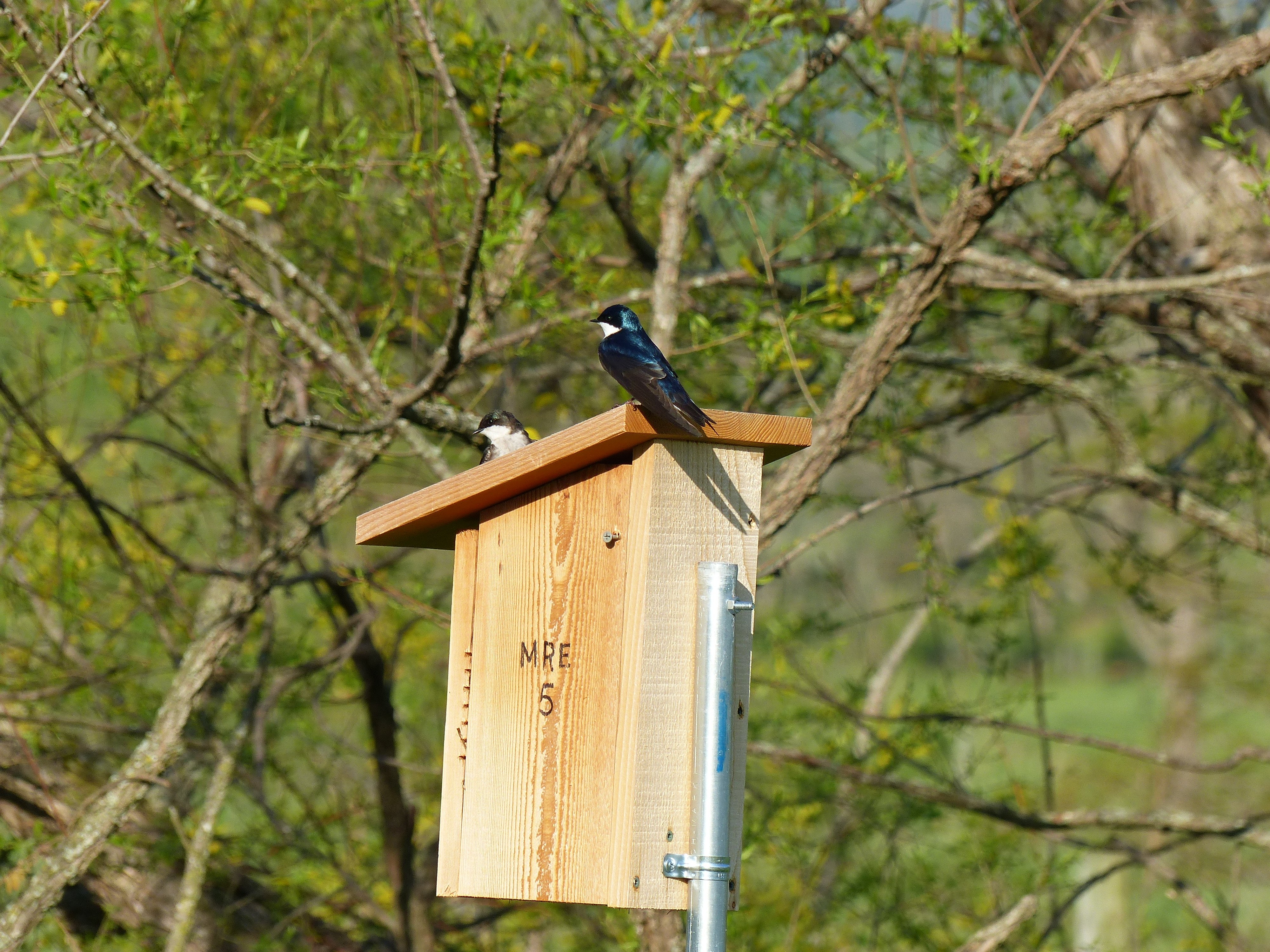
Tree Swallows guarding their nest box.
Tree Swallow populations overall have declined thirty percent between 1966 and 2019. The average date for laying their first egg has moved nine days earlier because of climate change.
Barn Swallows
The Barn Swallows arrive during the first week of April. They will take up residence in the lower cow barn, building their cup-shaped nests from tiny mud balls, which they attach to the hand-hewn beams of the first-floor ceiling. Last year, I counted 21 nests.

Barn Swallows arrive in Swoope during the month of April. They are summer residents.
Barn Swallow populations have declined twenty-five percent between 1966 and 2019.
Northern Rough-Winged Swallows
I see only a few Northern Rough-Winged Swallows each year. These swallows prefer to be around larger bodies of water than we have at Whiskey Creek. They nest in holes built and abandoned by other creatures in the steep bank along Whiskey Creek.

Northern Rough-Winged Swallow. Photo credit © Marshall Faintich
Rough-Winged Swallow populations have declined eighteen percent between 1970 and 2014.
Cliff Swallows
We were lucky to have a pair of Cliff Swallows a few years ago. They built their gourd-shaped mud nest in the lower cow barn along with the Barn Swallows. I have not seen them since. I’m hopeful for their return.

Cliff Swallow, notice the white forehead. Photo credit © Marshall Faintich
Cliff Swallow populations have remained relatively stable between 1966 and 2019.
August Farewell
Our swallows will gather up in August to prepare for their migration south, and then one day they will just be gone. I’ll clean out the nest boxes this winter and make repairs as needed for their return next spring.
Wildlife in Decline
It should come as no surprise that most wildlife populations are in steep decline. The number one reason is loss of habitat. As humankind paves paradise for parking lots and data centers, we destroy and degrade the ecosystems necessary for wildlife to survive. The number two reason for wildlife decline is invasive species. For example, the House Sparrow, not native to North America, will take over the nesting sites of Tree Swallows and all other native cavity-nesting birds.
Celebrate Earth Day
We don’t have to ask Alexa or Siri how to bring back wildlife populations. We already know the answer: protect existing habitats, improve degraded ones, reduce invasive species populations, reintroduce native species, and reduce human conflict with nature.
Here’s what you can do: vote for conservation, take out some of your lawn and go native, plant native trees, go to public hearings and speak up, join and support a conservation organization, go solar, trade in your gas-powered car for an electric vehicle or hybrid, support renewable energy. Put up a cavity nesting bird house.
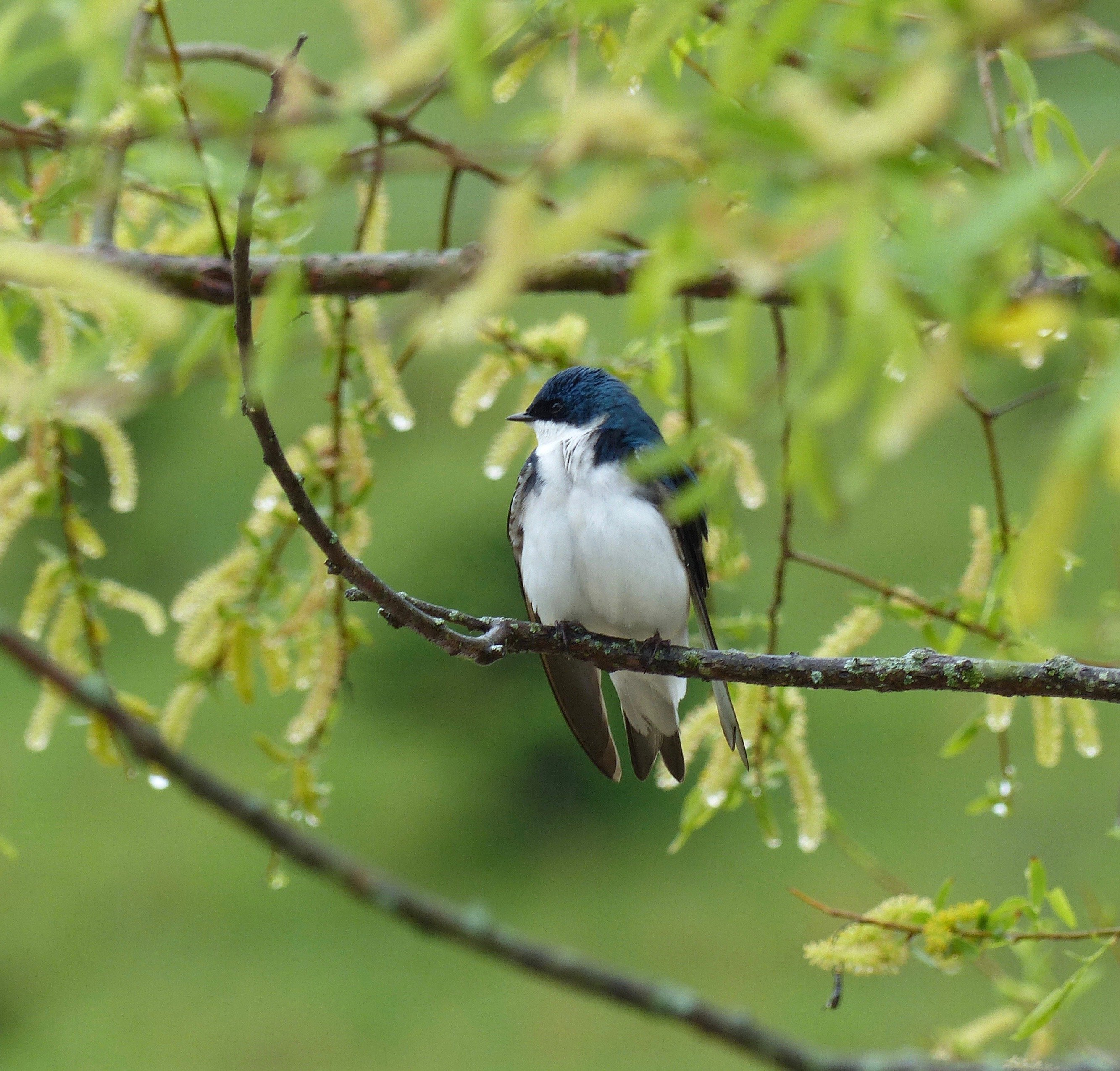
A Tree Swallow on our farm in Swoope.
Note: This was written by a real person: me. There are no paywalls, surveys, pop-ups, or AI. All photos by me unless otherwise noted.
The post Earth Day 56: Data Centers and the Swallows of Whiskey Creek appeared first on Getting More on the Ground.