Calving Season 2026
Last year, I published an article about the first month of calving at Whiskey Creek Regenerative Farming. Readers seemed to like it so I have posted this year’s journal entries. Calving always brings joy, learning, something different, and some heartbreak, but mostly joy. For new readers I have simply copied “calving background,” to give you the details of what should go on during this time.
For those that know the details just scroll down to the journal entries to find out how our first month of calving rolled out in 2026.
Calving Background
Whiskey Creek Regenerative Farming is a commercial cow-calf operation that uses perennial grass to produce calves for sale into all-natural beef programs supplying grocery stores such as Whole Foods.

Whiskey Creek Regenerative Farming is a commercial cow/calf operation in Virginia’s legendary Shenandoah Valley. We move the cows with their new babies to greener pastures.
Leased bulls are brought in on June 1 to impregnate our cows and taken out on September 1. Cows have a nine-month gestation period, so our calving season begins about March 1 and ends around May 1. A veterinarian does pregnancy checks on the cows in December to determine which are pregnant. This year, 31 cows and 14 heifers are due to give birth.
Heifers are young cows that haven’t had a calf yet. We put them in the field nearest the house so we can watch them closely. Since this will be their first calf, they sometimes need help. The cows are in the second field from the house. We check on them frequently throughout the day and night.
The following chronicle is from my journal. It focuses on this year’s calving season and lists the migrating birds that arrive on the farm, the flowers that bloom, and the seeds we plant in the garden. In no way do I mean to diminish all the other tasks that take place on the farm, such as moving and feeding the cows, checking their waterers, fixing fences, hanging gates, and re-staking the tree shelters on the farm’s nine acres of riparian buffers.
The Perfect Calving Birth
Most cows will give birth on their own. Usually, the calf is positioned in the birth canal with its front feet first followed by its head.

This heifer gave birth on her own and immediately began licking her baby.
We give the cows and the heifers every opportunity to calve on their own, but when there is no progress, we get them into the chute–a long narrow passage that leads to the head catch that stabilizes them so we can investigate what is going on.
When a cow leaves the herd, that’s often the first sign of labor. Twitching her tail, walking back and forth, not chewing cud, and licking her sides are other early signs. When the birth begins, a water bag emerges from the birth canal, becoming about the size of a softball. Next, the calf’s front feet emerge, followed by its head. Once born, the calf will get up within minutes and find its mother’s udder and begin nursing within an hour. A strong baby and a loving mother are the outcome we hope for, and the one we usually get, but we must be prepared if it’s not.
Tagging a Calf
After calves are born, we need to tag them so we know which mother is theirs and can identify them later. We have to catch them before they are 24 hours old; otherwise, we can’t catch them on foot because they can outrun us. We ride into the calving field in an old Jeep Cherokee. Jeanne drives and I sit in the back with the tailgate open. When we arrive near the cow and her calf, I hop out, give the cow a flake of hay hoping to distract her, and grab the calf. This is the tricky part of tagging a calf. Will the mother remain calm and allow me to grab her baby? Most of the time she will.
Once I have stabilized the calf, Jeanne gives the baby two shots of vitamins, drenches its navel with iodine, places a band around the scrotum if it’s a bull calf, and attaches an ear tag that matches its mother’s. All this takes place in less than 60 seconds. When a chronicle entry notes just the cow’s number and the sex of her baby, that’s what happened.

Tagging box with vitamins, iodine, band castrator, and tagger.
Move to Greener Pastures
After we tag the calf and we are sure the baby knows who its mother is, we move the pair to a separate field—the nursery field. We check and feed hay to three groups now: the pregnant heifers, the pregnant cows, and the mothers in the nursery.
The Chronicle for the First Month of Calving in 2026
Week One
3/1: 23 degrees. I checked the cows this morning in the pre-dawn light. Cow 106 had just calved. Checked 20 minutes later the calf had not gotten up. He was cold so we put him in the jeep and brought him to the cooker [It’s actually a calf warmer. See photo]. His temperature was 98 degrees. [Normal temperature for calves is 101. If they are cold, they will not nurse.] Very stiff. Hind legs would not bend. An hour later we gave him colostrum. Let him warm up another hour in the cooker and then took him to his mother.
Cow 34 calved. Nice.
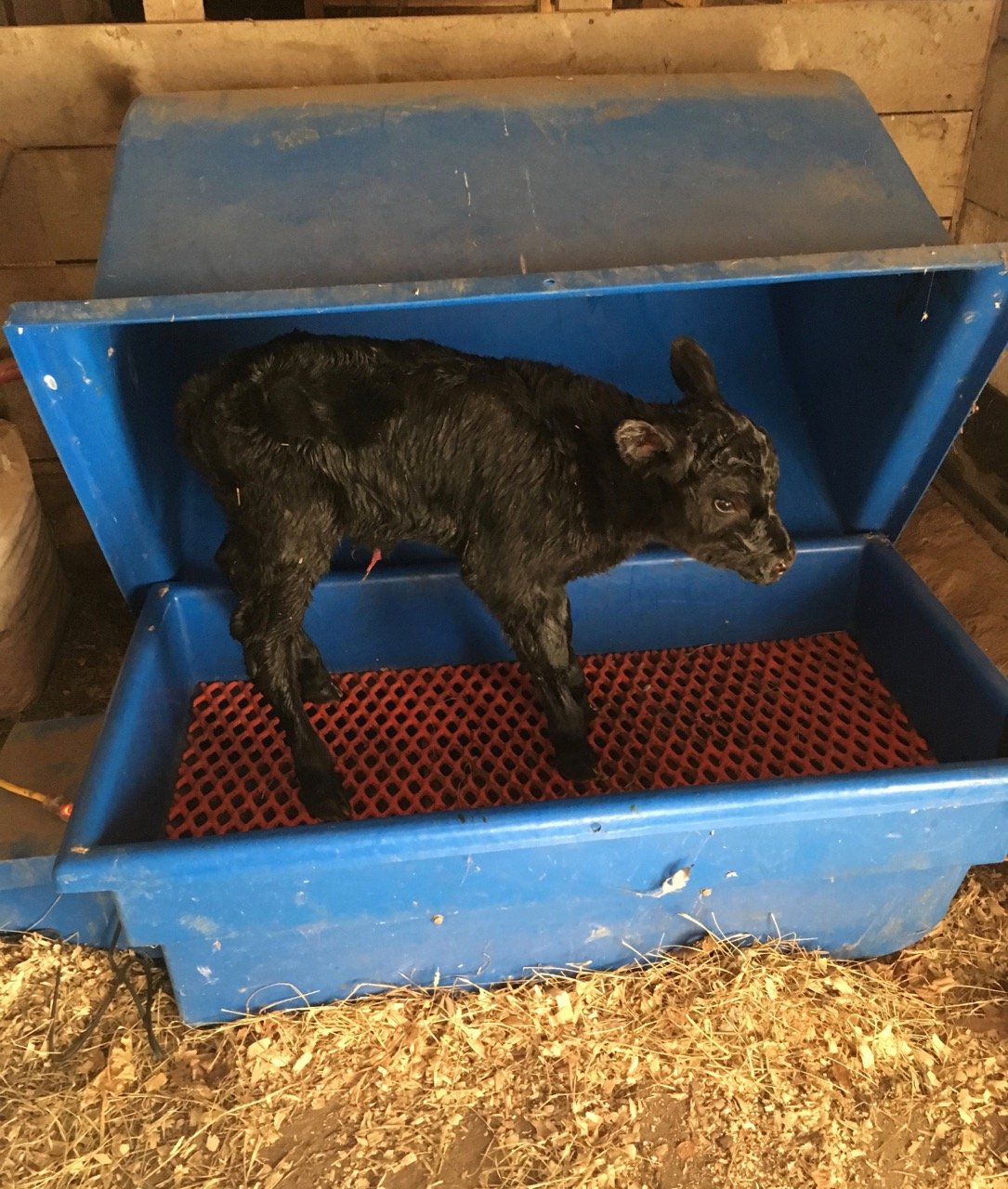
We call this the “calf cooker”. It’s actually a PolyDome Calf Warmer which has a small electric heater. We put cold newborns in it to bring their temperature up.
3/2: Calf 106 hasn’t nursed his mother yet. We put the mother in the chute and Jeanne milked her down into a bottle and gave it to the baby. Made a stall for the baby in the shop. Todd Wiseman (vet) came and gave the calf a shot of Exceed and several pills of meloxicam.
33 degrees and raining.
3/3: Calf 106 up and eager to nurse. Got his mother into the chute, Jeanne gave her drugs to settle her down. The little guy went to town nursing. Downtown! Jeanne smiles.
3/5: Red-Wing Blackbirds arrive. Hellebores in bloom.

Hellebore in bloom at Whiskey Creek.
3/7: Three calves born today: 107, 95, and 19. The 19 calf can’t get up. Front legs are turned over. Got the mother in and Jeanne milked her down, gave the colostrum to the baby from a bottle. Took him to the vet at his house in Swoope. We used a narrow tree shelter as splints on both front legs.
Put him in the shop for the night. Took the splints off. They didn’t seem to help.
Week Two
3/8: Calf 19 more lethargic than yesterday. Wont nurse a bottle. I tubed him. [An esophageal feeding tube is inserted down the throat and once near the rumen a valve is opened and the milk and or electrolytes from a pouch flows into the rumen.]

An esophageal feeding tube with pouch for calves.
We concluded that there were more issues than just the front legs and sadly decided to put the calf down. Charlie Schooley had a two-day old calf that did not have a mother.
Skinned the dead calf and put it on the orphan calf. Got cow 19 in the chute, drugged her and placed the orphan near her udder. He went downtown on nursing.
3/10: Cow 105 calved. Nice.
Maple trees blooming.
3/11: Cow 30 calved. Nice.
3/13: 23 degrees. Cow 66 calved. Nice.
Week Three
3/15: Tree Swallows arrive. Planted peas.
3/16: Cow 04 and 104 calved. Nice.
3/17: Windy and cold. 33 degrees. Cow 68 calved. She’s mean, must sell her. Calf is good. Cow 94 calved. Nice.
3/18: 17 degrees. Calf 39 can’t walk. Put her in the cooker. Gave her colostrum. Took her to Westwood Animal Hospital. Vet Tom Cromer put short splints on ankles. Jeanne milked the mother down and tried to give it to the baby via a bottle but she would not take it. I tubed her. She slept in the shop.

Calf 39 with splints.
3/19: Calf 39 is alive. It was a sleepless night. Got the mother in to see if the calf would nurse. Used a block of wood with a rolled-up towel to get the baby elevated to her mother’s udder. No go. Jeanne milked the cow and I tubed the calf again.
Put them out in the pen.
Cow 17 calved. Nice.
Cow 92 calved. Nice.
Jeanne found the 39 calf in the culvert outside of the pen! She had crawled out of the pen. Put the calf under the mother in the chute again on a block of wood and this time she got it!

Calf 39 with a block of wood under her to get her high enough to nurse.
3/21: Cow 9B, 92, and 131 all calved. Nice. Calf 39 nursing her mother in the chute on the block. Each time she swallows both ears twitch.
Week Four
3/22: Cow 35 calved. Calf has twisted spine. Left rear leg is larger than the other one but doing okay.
3/23: Calf 39 nurses on her own after six days of persistence and care from Jeanne. Cow 62 calved. Nice.

Calf 39 nursing on her own.
3/24: 34 degrees. Cow 60 calved. Calf slightly over on ankles but not bad. Bought wrist braces at Augusta Health to see if that would work to help calf 39 walk.
Planted potatoes, spinach, radishes.
3/25: Cow 010 calved. Nice. Calf 30 and 105 have scours [farmer speak for diarrhea]. Darted calf 30 with the antibiotic draxxin. I used our last 3cc dart. Got calf 105 in the chute to treat. Put both pairs in upper barn lot to minimize contamination or spread to other calves.
3/26: Chipping Sparrows arrive.
3/28: 106 calf has green scours. Darted him with a 4cc dart (1cc Draxxin, 1cc multi-min, 2cc saline)
Week Five
3/29: The 35 calf has the scours now. Jeanne and I walked him and his mother into the pens, and we got the little one in the chute. Jeanne collected a fecal sample from him then called the vet to get advice. She gave the calf a shot of Draxxin and Pepto Bismal tablets down the throat. Put them in the infirmary lot.
Both 02 and 106 have the scours and luckily, we captured them in the watering coral. It’s a 40’ X 40’ enclosure with guard rail. Jeanne used a lasso to catch the 02 calf. These calves are not lethargic. They are still nursing their mothers, and I could never catch one on foot. Once Jeanne secured the rope around the neck and one leg of the calf, she cinched it up tight and the 200-pound calf started running around like you would see in a rodeo. She dallied the rope off on one of the posts and we worked together to bring the bouncing, lurching calf to a halt by moving him ever closer to the guard rail while shortening the rope. One secure, Jeanne gave the calf the medicine he needs to get better.
We repeated that procedure with calf 106. We hope for no more sickness.
I forgot to document but Cowbirds arrived days ago. Juncos and White Throated Sparrows are still here.
3/30: Cow 103 calved. Nice. Calf 39 continues to improve. Took fecal sample of scours to VDACS lab in Harrisonburg. Took splint off Calf 39 right knee for the night.
Yellow-rumped Warblers arrive, Service Berry begins blooming.
3/31: Cow 14 calved. Nice. Calf 35 still has the scours, bad. Jeanne called the vet. Vet said to tube him with electrolytes. Roped the calf in the pen. Jeanne gave him a scours bolus and I tubed him.
Note: This was written by a real person: me. There are no paywalls, ads, surveys, AI, or pop-ups. All photos were taken by me.
The post Springtime and the Chronicles of Calving Season 2026 appeared first on Getting More on the Ground.