
Imagine paddling a canoe upstream forever. That’s my metaphor for environmental activism. Activists have been paddling against the current with the Clean Water Act on their backs ever since its passage 50 years ago. We have made a lot of progress, but it’s been against the current the whole time—and we are still paddling.
The First 20 Words of the Clean Water Act
The objective of this chapter is to restore and maintain the chemical, physical, and biological integrity of the nation’s waters.
The main goal of the Clean Water Act in 1972 was to cease industrial and municipal point source water pollution without a permit imposing limits on what can be discharged. Point source water pollution is basically a discharge into a waterway from a pipe. Thanks to the Clean Water Act, all point sources of water pollution must be permitted; if they are not permitted, they are illegal. This monumental achievement was accomplished through cooperative federalism. That’s the process through which federal and state governments work in partnership to solve problems. In this case, the Environmental Protection Agency (EPA) allows state agencies to administer the National Pollutant Discharge Elimination System Permit process.

Point source water pollution. Photo credit Shutterstock Toa55
I was a sophomore in high school when the Clean Water Act became law in 1972. I can say without hesitation that our rivers and the Chesapeake Bay are cleaner and healthier than they were then. But, and that’s a big but, it didn’t happen without constant pressure from the environmental community. Every inch of progress toward cleaner water in this nation has been made with strength and endurance against a current of politics fueled by greed and power. A classic example of that work is the passage of the Clean Water Act itself and its subsequent implementation.
Nixon Vetoes the Clean Water Act
President Richard Nixon had had 10 days to sign the Federal Water Pollution Act. He vetoed it just before midnight on October 17, 1972, and Congress was to adjourn the next day. That allowed only one day for both the Senate and the House to override his veto and pass the bill without his signature. If they couldn’t do it—with a two-thirds vote from both chambers—the bill would die.
Nixon said he vetoed the bill because of its $24.6 billion price tag. He felt it was too expensive for the country. His administrator for the EPA, William D. Ruckelshaus recommended passage of the bill and the funding in a memo to the head of the Office of Management and Budget. “It seems reasonable to me,” he wrote, “to spend less than one percent of the Federal budget and .2 percent of the Gross National Product over the next several years to assure for future generations the very survival of the Gross National Product.”

William D. Ruckelshaus was the first administrator of the U.S. Environmental Protection Agency and encouraged the President to sign the Clean Water Act. Photo credit EPA
The next day Congress overwhelmingly overrode that veto, and the bill, now known as the Clean Water Act of 1972, became law.
Nixon Impounds EPA’s Funds
Frustrated that Congress overrode his veto and displeased with the price tag of the bill, the president refused to allocate the money. He impounded it instead! (Congress passed the Impoundment Control Act of 1974 in response to his actions.)
The City of New York and other municipalities in dire need of funding for wastewater treatment sued the EPA for not allocating the money.
It took two years of litigation for the case, Train v. City of New York, to reach the Supreme Court of the United States in 1974. By that time Nixon had resigned as president over the Watergate scandal. (Recall that Vice President Spiro Agnew resigned over tax evasion and corruption on October 10, 1973, Gerald Ford was appointed to replace him and then became president when Nixon resigned on August 8, 1974.)

Vice President Gerald Ford, Betty Ford, Pat Nixon, and President Richard Nixon walk to Army One helicopter during Nixon’s final departure as president, August 9, 1974. Photo credit National Archives, Richard Nixon Presidential Library
SCOTUS ruled unanimously on February 18, 1975. The president cannot impede the will of Congress by impounding funds it expressly allocated.
WOTUS Definition Remains Ephemeral
Ever since the passage of the Clean Water Act in 1972, we have been struggling, paddling upstream, to define the waters of the United States (WOTUS). Just how far upstream does the federal government have jurisdiction to prevent pollution? The executive branch has been rewriting the rule with each passing administration. Democrats argue “not far enough” as with the Obama administration rule and Republicans argue “too far” as with the Trump administration rule. The Supreme Court has heard arguments over the definition several times. The rule has been remanded back to the EPA and the Corps of Engineers to clarify. Until then the pre-2015 rule stands.
The Final Paddle—Nonpoint Source Water Pollution
Nonpoint source pollution is now the leading cause of pollution in the nation’s waters. This pollution comes from many sources such as urban stormwater runoff, poorly managed farmland, and the deposition on the water of contaminants from the air. Section 303(d) of the Clean Water Act mandates that states identify polluted (impaired) streams and develop plans to remove them from what is often called the state’s “dirty waters list.” Those plans are called Total Maximum Daily Loads (TMDL). These are basically pollution diets that limit the amount of pollution that can enter a stream.
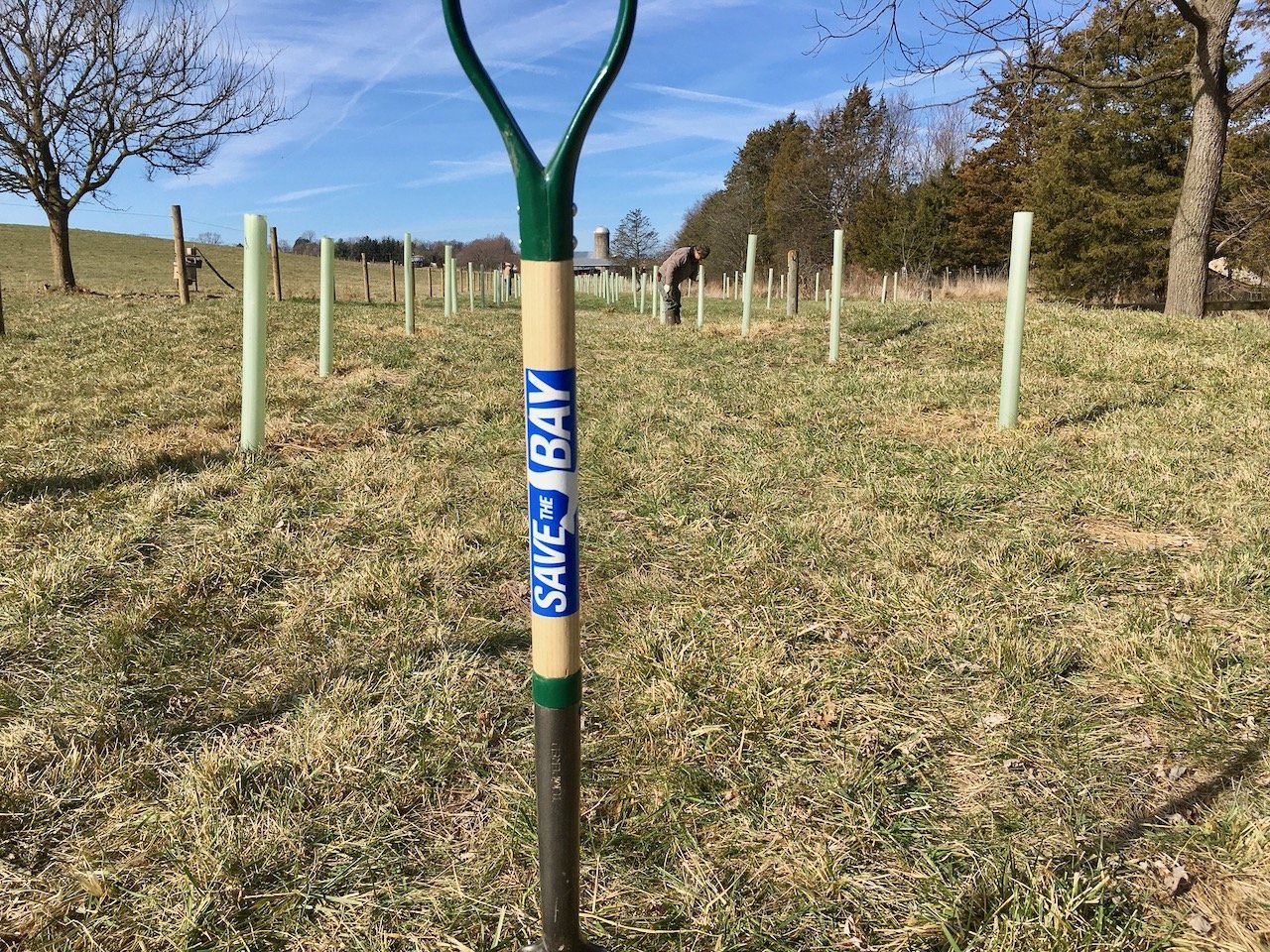
Planting trees is one of the best ways to prevent nutrients and sediment from entering a stream. Photo credit R. Whitescarver
The Chesapeake Clean Water Blueprint
The nation’s largest estuary, the Chesapeake Bay, is on the dirty waters list. It’s polluted by too much nitrogen, phosphorus, and sediment. The plan to reduce those pollutants from the 64,000-square-mile, six-state watershed is called the Chesapeake Clean Water Blueprint. It’s our TMDL. We are still paddling upstream since it was approved by the EPA in December 2010. Deep-pocketed polluters sued the EPA over the plan but lost after five years of appeals that ended up on the steps of the Supreme Court, which refused to hear American Farm Bureau v. EPA. The ruling from the lower courts stands. The Chesapeake Clean Water Blueprint is the law of the land.
Get in the Boat and Help Us Paddle
To find out what you can do to help clean up the waters of the United States or the stream in your backyard, contact your local Soil and Water Conservation District.
If you suspect a violation of a point source water pollution permit, report it to your local waterkeeper or the Waterkeeper Alliance immediately.
The post Paddling Upstream and the 50th Anniversary of the Clean Water Act (JMU 2022) appeared first on Getting More on the Ground.
