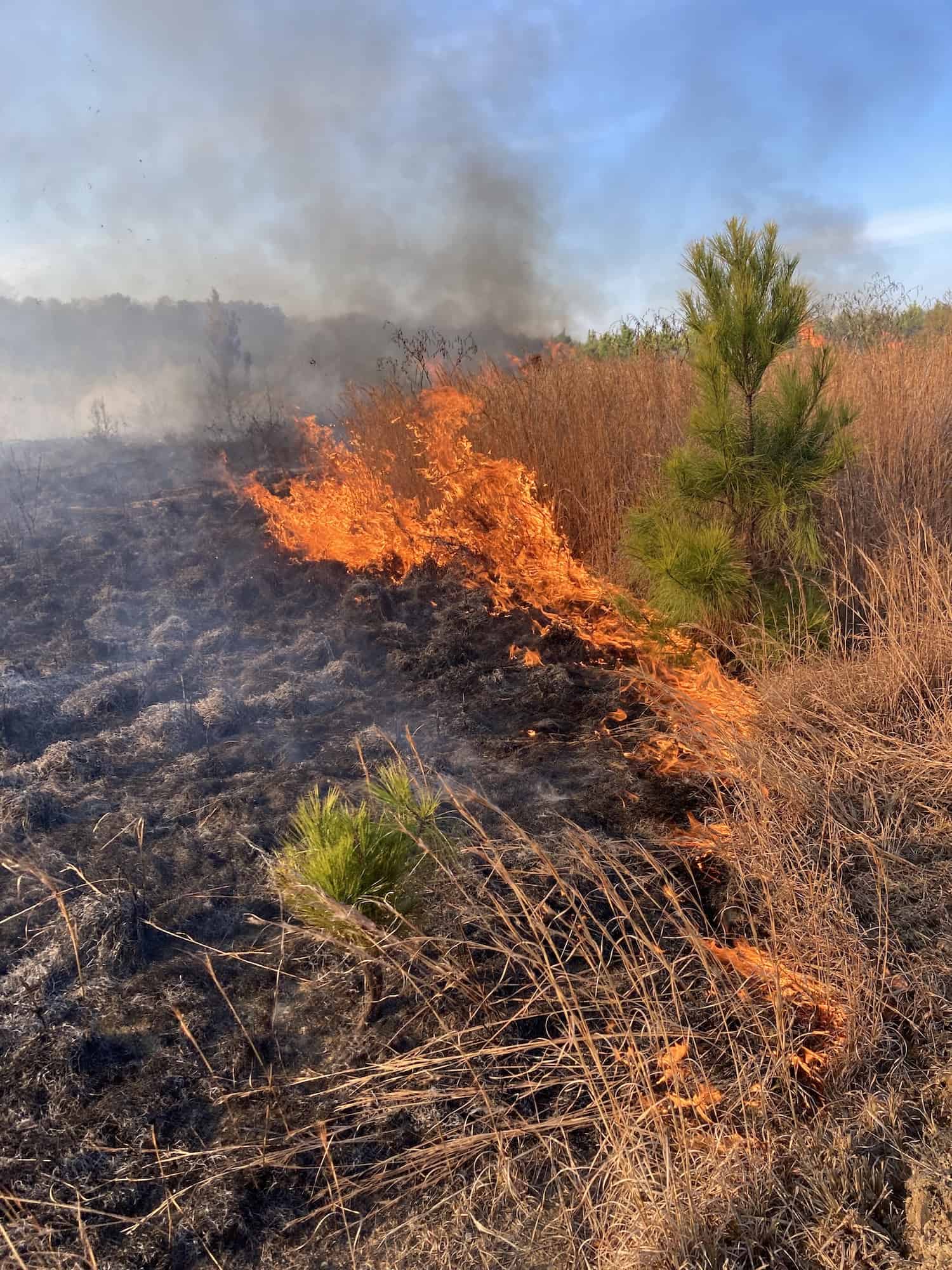
In Virginia, many ecosystems in the Coastal Plain and Piedmont region benefit and sometimes depend on the presence of fire. Long ago, fires naturally occurred due to lighting strikes. Occasional fire events allow plant species that are suppressed by competition the opportunity to sprout up from viable seeds stored underground.
In early December, CRLC worked with professional crews from the Virginia Department of Forestry (VaDOF) to plan and conduct our first prescribed burn at the Varina LandLab. By bringing fire back to CRLC’s Varina LandLab in Henrico County, Virginia, we hope to boost plant species diversity.
Working with the Experts
The VaDOF is certified through the National Wildfire Coordinating Group (NWCG). The NWCG standards require prescribed burns to be administered using a burn plan which maximizes safety. These plans require specific weather conditions to be met in order for a burn to be implemented to minimize the impacts of smoke and to direct smoke away from sensitive areas.
Having previously laid out specific areas (burn units) for a prescribed fire, a fire plow was used to create long linear paths 6 feet wide. Once the burn units were sectioned off by a safe buffer, a crew of professionally trained prescribed burn applicators from VaDOF used drip torches to light a long continuous thread of fire intended to move uniformly across the burn unit. After each unit was sufficiently burned, the crew moved to the next unit.
The target areas for the controlled burn were previously harvested areas that had grown up in dense broomsedge (Andropogon virginicus), a tall, native warm-season grass as well as scattered volunteer loblolly pine. The conditions for a prescribed fire were ideal the day of the burn, with ample ground moisture and rain predicted soon after. The goal of the prescribed fire treatment was to reduce the dense broomsedge, return nutrients to the soil and create space for other species to proliferate. Occasional fire events allow long suppressed species to sprout up from viable seeds stored underground.
Benefits of Prescribed Burns
Although fire has been suppressed since the colonial area through land conversion to agricultural, pastoral, and urbanized areas, fire still has an essential role in maintaining natural ecosystems (Noss, 2013). Botanists have observed the value of fire in Virginia, finding the highest diversity of native plants in areas that experience periodic disturbances, such as military bases or managed maintenance right of ways like areas under power lines.
Local biodiversity is highest when disturbances are neither too rare nor too frequent. At low levels of disturbance, competitive organisms (like fast growing or aggressive plants) will crowd out less competitive ones, dominating the ecosystem. Invasive plant species like Japanese honeysuckle, johnson grass, and stiltgrass are good examples of plants that can take over without distance by fire.
Invasive species are not a major issue at Varina LandLab. Instead native broomsedge dominates significant portions of our grassland areas. Boomsedge benefits wildlife like grassland bird species and is a host plant to the Wood Nymph butterfly (Cercyonis pegala). However, the broomsedge is acting as a monoculture, crowding out what could be incredible plant diversity.
The conservation of plant diversity is important in the Richmond region. Increased plant diversity also promotes diverse bird, insect, and wildlife communities.
Looking Forward to Spring
The goal for this burn was to understand if returning this natural disturbance regime to the landscape will help facilitate an increase in plant species diversity. Come spring 2023, there will be a rebirth of these burned areas. Like opening up a time capsule, we will be watching with anticipation what emerges from the ground for the first time since fire has been suppressed from the landscape.
In addition to adding much needed disturbance to help promote diversity, there are a myriad of benefits of conducting a safe and successful controlled burn, including:
- Reducing the prevalence of ticks and even certain tick-born diseases (Gleim et al. 2014)
- Promoting the growth of native grasses, forbs, and other fire dependent species
- Reducing fuel loads such as dead and down trees, further reducing the future risk of severe wildfire
- Controlling non-native invasive plant species
- Creating a mosaic of habitats for a variety of plants and animals
- Clearing land of young trees and shrubs that shade out grassland and other sun-loving plants
- Maintaining grassland habitat that grassland specific wildlife depends on, like, quail, northern harrier, American woodcock, prairie warblers, and northern bob whites, which are experiencing declines in grassland habitat in Virginia
We hope that this prescribed burn at Varina LandLab will help demonstrate the benefits of prescribed fire as a powerful natural land management practice; one that landowners can opt to implement by trained natural resource professionals to manage their land in the Richmond region.
Citations:
Ewing, Kelly. Managing a Right-of-Way Helped This Park Restore Its Grasslands. National Park Service, 2021.
Gleim E. R., Conner L. M., Berghaus R. D., Levin M. L., Zemtsova G. E., Yabsley M. J. The phenology of ticks and the effects of long-term prescribed burning on tick population dynamics in southwestern Georgia and northwestern Florida. PLoS One, 2014.
Johnson, Amy and Wiedenfeld, D. In Virginia’s Piedmont Grasslands: a Firmer Foothold for Declining Birds. American Bird Conservancy, 2020.
Noss, Reed F. Forgotten Grasslands of the South. Island Press, 2013.

Ashley Moulton
CRLC Land Conservation Specialist
The post A Fire-Loving Landscape: Prescribed Burns at Varina LandLab first appeared on Capital Region Land Conservancy.