October is Riparian Buffer Month. How Could I Not Write About That?
Note: This post was written by a real person–me. All photos by R. Whitescarver unless otherwise noted.
Walking under the shade of the trees we planted along Middle River, I look up and see abundant acorns. I smile. Further along, I feel the bark of a Willow Oak and marvel at its height, now well over 30 feet.

These Red Oak acorns provide food for wildlife and the leaves provide food for the aquatic insects in the river.
The Middle River begins as several springs that bubble up out of the ground six miles south of our farm in Swoope. It is nine feet wide when it gets to our property and meanders through it for a half mile. In 2004, we fenced the cows away from the river and planted native trees and shrubs to create a riparian forest buffer.
Cattle Destroy Streams
On warmer days, the cattle on different farms upstream from us trample the banks of the river and lounge in the water, and by the time the river gets to us, the river is so laden with sediment that it looks like chocolate milk flowing. Sediment clogs the gills of aquatic insects and destroys the health of streams, rivers, and the Chesapeake Bay.

Cattle have free access to most parts of the upper Middle River. They destroy the aquatic ecosystem by trampling the stream banks, dislodging soil, and defecating in the water.
But now that the weather is cool, the cows upstream are not in the river, and the water is clear. Most of the stream banks on our farm have healed, and I am comforted knowing that what we did on this farm nearly 20 years ago—fencing the cows away from the stream and planting trees—was the right thing to do.
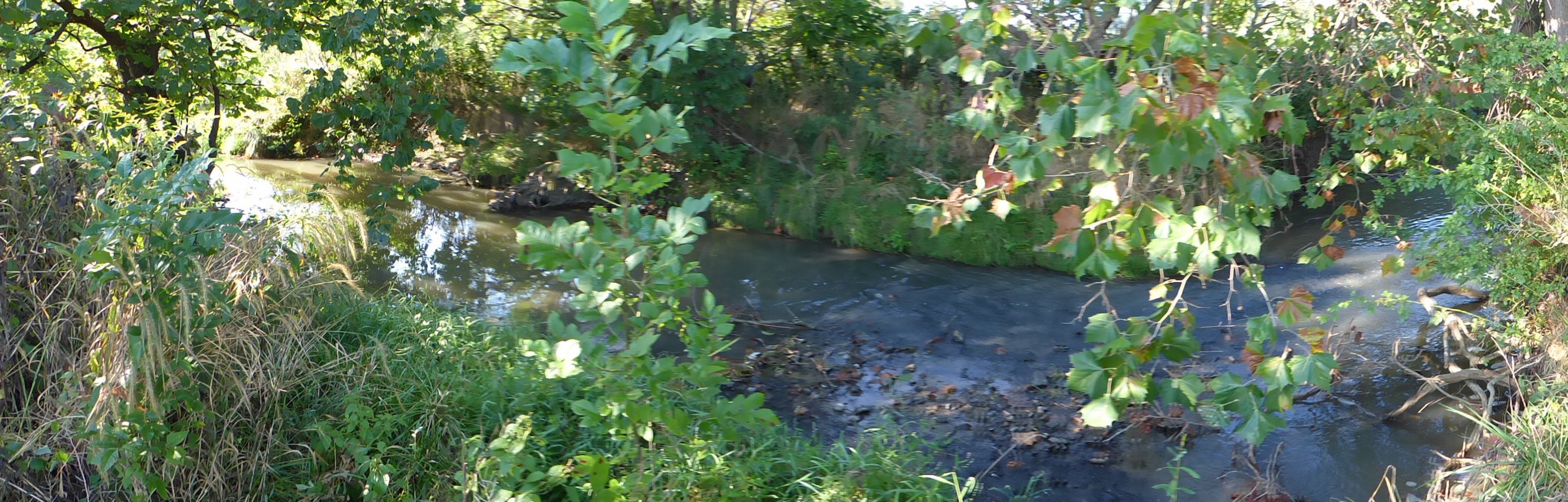
Middle River flowing through our farm in Swoope, Virginia.
Treasures in the Riparian Buffer
I find lots of treasure walking along our riparian buffers. In the fall, one treasure is the burnt orange plumes of Indiangrass slowly dancing in the breeze. I heard a quail here earlier this year, most likely the sole survivor of the 10 pairs we released two years ago. I lament that we have not been able to reestablish the quail population yet. We have the habitat, but there are too many predators.

Indiangrass along with other native plants were planted in this part of our riparian buffer for quail habitat.
In 2013, we released 20 quail on this farm, and in October 2015, I saw a covey (a family of about 14 birds including young ones) of quail right here on this farm. In my opinion, the solution is to create more suitable habitats, release more quail, and reduce the predator population, especially free-roaming cats—the most destructive, nonnative mammal in North America.
Riparian Buffers Create Wildlife Habitat
Our quail habitat is suitable with lots of shrubs and native grasses. We planted False Indigo shrubs, Indiangrass, Big Bluestem, and Switchgrass, which are all well-established now, and many native plants came on their own, including Goldenrod, Boneset, Jewelweed, Grand Lobelia, Canada Wild Rye, and Wingstem.

Goldenrod is good for quail habitat and is a powerhouse for pollen and pollinators.
I continue walking and flush up a family of Wood Ducks in the river. The summer birds have all migrated south now. Tree Swallows, Willow Flycatchers, Yellow Warblers, Orioles, and Indigo Buntings nest here in the riparian buffers with native trees and shrubs. We now await the arrival of the winter birds, which include several Sparrow species, Common Snipes, and Short-Eared Owls.
Riparian Buffers Reduce Pollution
Reflecting on what Jeanne and I did on this farm makes me smile. It wasn’t hard to do, and the trees are so big now. The buffers provide habitat for wildlife and improve the river’s health. As a volunteer for the Friends of the Middle River, I sampled the water for E. coli every month for four years, and the average reduction from going through our riparian buffers was 55 percent.

This Willow Oak at our Middle River farm was planted in 2004. It is now over 30 feet tall.
That’s a huge reduction, and it came about for several reasons. Our cows no longer defecate in the river. Dilution and time and sunlight also play a part. But the biggest factor in the improvement is that the leaves from native trees provide the necessary food for a thriving aquatic ecosystem that is capable of consuming pollutants.
It’s comforting knowing that the river is cleaner leaving our farm. I can see it and science proves it.

Bobby and Jeanne in the 19-year-old riparian buffer along Middle River. Photo credit Adam Miller
“I believe that if we had well-functioning riparian buffers along all the streams in our watershed, we could remove our river from the state’s Impaired Waters List and return Virginia’s state fish, the Brook Trout, to its waters.” That’s a quote from my book, Swoope Almanac, Stories of Love, Land, and Water in Virginia’s Shenandoah Valley. It has a whole chapter on riparian buffers.
Incentives For Riparian Buffers Exceed 100 Percent of the Cost
Funding for establishing riparian buffers has never been greater. Contact your local Soil and Water Conservation District or USDA field office to find out more. And, of course, contact me; I’ll gladly help you.
The post Riparian Buffer Walk 2023 appeared first on Getting More on the Ground.