
When we first moved to Whiskey Creek in 2020, Jeanne asked me why there weren’t any birds here. “It’s because there is no habitat for them,” I responded.
The Gardens of Whiskey Creek
We have many gardens now at Whiskey Creek. The vegetable garden, the cut garden, the shop garden, the garden at the flagpole, the garden at the cattle pen, the fig tree garden, the lilac garden, the fire-poker garden, the native garden, the mushroom garden, and others we haven’t named. Jeanne and I will walk around most evenings during the growing season with a glass of wine and marvel at the coming and goings of every bloom.

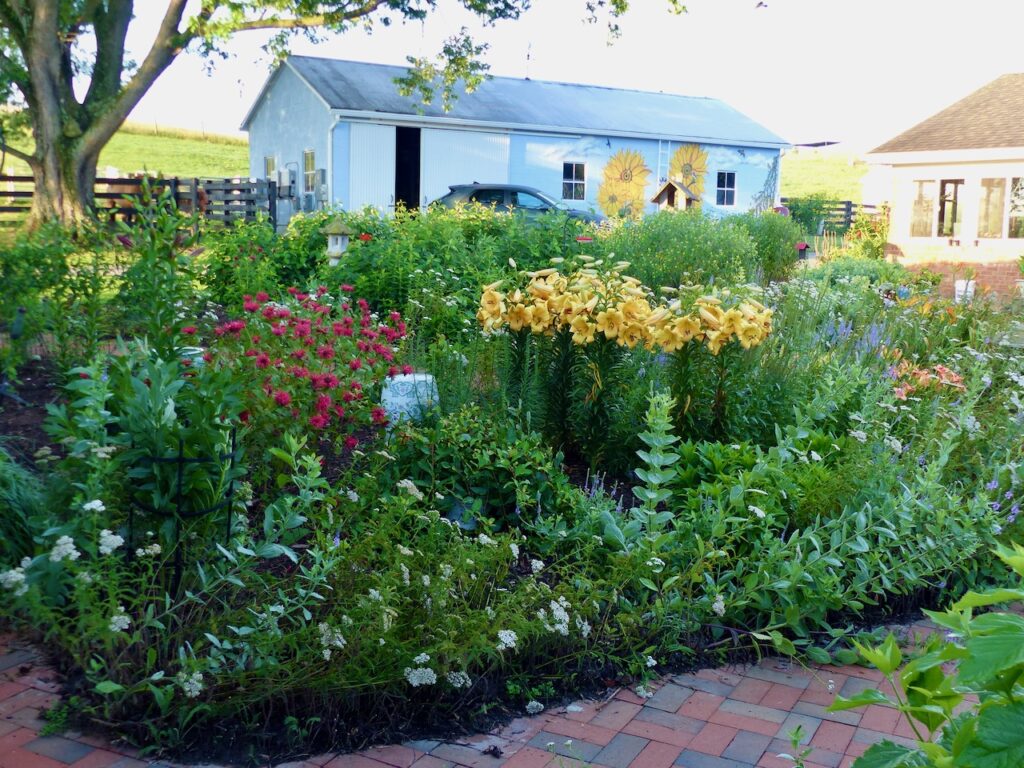
One of the gardens at Whiskey Creek.
Beginning in late February blooms include pussy willows, hellebores, bluebells, and maples. Then the month-long ascension of over a thousand daffodils followed by baptisia, speedwell, bee balm, and liatris. And finally, the fall beauties of lobelia, goldenrod, jewelweed, and Joe-Pye weed. There are too many to list and most are native.

Bumble bees on Speedwell at Whiskey Creek
The Native Garden
The native garden is where we sit in the evenings and experience the bird magic – Hummingbirds whizzing by, Catbird’s meowing, Brown Thrashers running between the plants and Cedar Waxwings eating the fruits from the Serviceberry tree. There are many other birds, but these are indicator birds that let me know we have a very special place. Several years ago, this special garden was just lawn, devoid of wildlife.

Cedar Waxwings in the Serviceberry tree outside our dining room window. Photo credit Jeanne Hoffman
Now we have birds, bees and all sorts of other pollinators. The plant that attracts the most pollinators in our gardens is Joe-Pye Weed. I stand close to it and just stare at all the bees, butterflies and bugs. The plant was named after a Native American medicine man, Joe Pye, that used the plant to treat fevers. Legend has it he saved a whole village from Typhoid fever by treating them with this native plant.

Jewelweed in the foreground, Joe-Pye weed in the background.
The Mushroom Garden
A couple years ago we worked with mycologists Chris and Vicki Vacher of Enchanted Nature to establish a Wine Cap mushroom garden.
We needed a supply of fresh wood chips, and it just so happened that our neighbors had a Silver Maple that had to be taken down and the tree company was going to make wood chips out of its branches. We asked if we could have some of the chips. The next day a tractor trailer loaded with wood chips drove up to the house. The driver asked where we wanted the chips. Jeanne said we just wanted a pick-up load and the driver said, “Lady, you have to take the whole load.”
It was a mountain of wood chips and perfect to establish a mushroom bed. We inoculated the bed with two gallons of Wine Cap mushroom spawn, and we’ve been eating these mushrooms ever since.

A harvest of wine cap mushrooms at Whiskey Creek.
Eat What’s in Season
One of the core principles of regenerative agriculture is to eat what’s in season. This reduces energy-intensive long-haul transport of food, reduces your carbon footprint, and supports local farmers.
We do this at Whiskey Creek Regenerative Farming as much as we can. This spring we had a lot of wine cap mushrooms, and I made a meal using everything from the farm: wine caps, garlic scapes, asparagus, and Whiskey Creek beef. Here’s the recipe.
Lessons Learned
I’d much rather weed a perennial garden than mow grass. Gardens, of all types are beneficial in many ways. They provide habitat for pollinators and birds, food for us to consume, and a place to enjoy the sounds and sights of nature.
My advice to anyone: take out some lawn and plant something native.

Native bee balm attracts many pollinators.
Note: This was written by a real person: me. All photos by me unless otherwise noted. There are no paywalls, ads, AI, or surveys.
The post The Gardens of Whiskey Creek appeared first on Getting More on the Ground.